I followed Jesus one day.
It was just a few years ago in the Fall, before Jesus became better known. I first met him through a mutual acquaintance—we both happened to be at a Concordia football game with a group of friends. A couple of weeks later I ran into him again at the Benny library. But the day I’m talking about, the day I followed him, was a day we were both waiting for the bus on Sherbrooke Street over in NDG—the 105.
I don’t know about you, but when I see someone I know at the bus-stop I often avoid eye contact—especially first thing in the morning. Typical introvert behaviour. I especially avoid eye contact with people who are, you know, a little different from me. I’d put Jesus in that category on that day. I had only gotten to know him in some small way. But he didn’t seem easy to figure out; little too serious, maybe, even if he was also interesting and thoughtful in his way.
In any case, I would have been happy to just stay in my own little world that morning, oblivious to others. But I ended up standing right next to him at the back of the bus — so we started to chat.
I was on my way down to the college, for work. I asked where he was off to, and he said he was going to meet up with a cousin of his. He mentioned that this cousin had gone down a kind of different path from others in his family and community. His cousin had apparently become involved with a group of what Jesus called “religiously serious” people. His cousin seemed to have become involved with a marginal religious community that had a love-hate relationship with society.
I should perhaps say that Jesus’ family is Jewish. “Jesus” is actually just his anglicized name—his name is actually Yeshua. And the cousin he mentioned is Yochanan. They both grew up attending a synagogue not too far from where I live in NDG.
As we chatted on the bus, Jesus asked if I had to go straight to work—he asked if maybe I’d be interested in going with him to meet this cousin of his. Jesus already knew I was interested in theology. He knew that I worked at a theological college. He thought I might be interested in this little sect or religious community his cousin was involved with. Maybe I could explore it as a case study of religious renewal groups or marginal religious communities.
My more comfortable place, religiously speaking, is probably singing hymns or worship songs in church on Sunday morning, or in the classroom if an historic, university-affiliated college. But I was interested. I figured I didn’t have anything to lose. I wasn’t teaching that morning. Unusually, I had no meetings. So, why not join him?
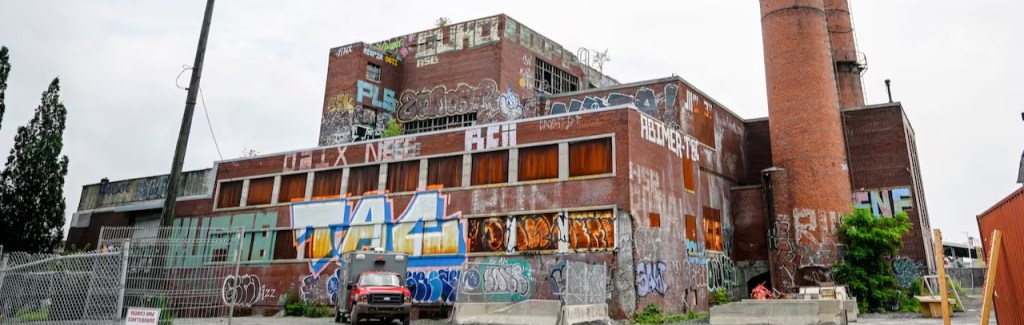
I said to Jesus: “Ok, so where are we going?” Turns out we were heading almost to the end of the Green line in the East end—L’Assomption station. From there we were going to walk to the Dickson Incinerator—an abandoned industrial site where Yochanan and his fellow travelers had been squatting; living together in the old buildings. Oh, I thought. Well, I’m in now.
When we arrived, it was maybe as you’d expect. John looked like the kind of guy you’d expect to be hanging out in an abandoned industrial site—decked out in rough-looking thrift-store attire. John, Yochanan, was remarkably clear-eyed and articulate. As we began to chat it quickly became evident that Yochanan spoke with ease and clarity about faith—he was theologically articulate. His faith was also shaped by more than a tinge of anger. Within just a few minutes of starting to speak with him, he was lashing out at contemporary society
lashing out at our failure to live good and beautiful lives;
lashing out at our consumerism;
lashing out at the self-righteousness he said we all exhibit;
lashing out at our forgetfulness of God.
It was almost breathtaking, actually. On the one hand, his righteous anger was palpable. But he seemed equally animated by a deeply held and beautiful hope. He knew the Hebrew bible much better than I did—like the back of his hand. He could quote the old prophets like it was nothing.
The fact that they were squatting, living, in this old, industrial incinerator complex was no accident. Yochanan put it like this: If you want to be faithful to the God of Abraham and Sarah, the God of Moses and Miriam, the God of Esther and Elijah—if you want to be faithful to this God, it requires making a break with today’s society. Being faithful means making a break with almost everything we know, appreciate, and find comfortable.
Some of his words still echo in my ears today and they still sting a bit. He said: “We might think we are living good enough lives, but mostly the things we value things are like the garbage that used to be incinerated in this place. So much in our lives would be better if it was burned up to nothing.”
John and his group squatting in the east end—they believed that we needed to think very differently and live very differently and relate to God very differently. They also wanted to symbolize this difference, they wanted to symbolize this change we need—they did it with the idea of washing. Yohanan and this group had hit on a kind of baptism as the ritual by which people could symbolize this change of life and faith.
In an old control room of the incinerator complex they had set up one of those antique white, cast iron bathtubs. They probably picked it up from an old demolished or renovated house nearby. The tub sat there in the graffiti-marked control room looking remarkably new. It had beautiful pedestal feet, sweeping sides, and a deep basin. It was full of water. Not a huge number of people had joined the group through being baptized, but apparently some had. Some of those who were baptized stayed on with them, squatting in that jumble of buildings. Others had gone back to their everyday lives.
As we talked it also became clear that John and Jesus were different people—cousins, yes, but also with diverse upbringings and their own sense of identity. It’s also true, though, that Jesus seemed aligned with what John was doing. Jesus didn’t object to any of the hard and hopeful ideas John shared.
In fact… it turned out that Jesus had decided this was the day he would get into that beautiful old bathtub. This was the day he would be immersed in the water and enter this new beginning with God. When we were chatting on the bus a few hours earlier I didn’t know it, but Jesus was inviting me to his baptism.
This is where it got interesting. For all of the fact that Yochanan was the more fiery figure, for all of his confidence in conversation, for all of his loud insistence on our need to change everything, he became very quiet at the idea of baptizing his cousin Yeshua.
In fact, there was a kind of standoff between them. John was saying: No, this isn’t right. I can’t baptize you. You may not be squatting here with us, but you understand my message more than I do. I might be a leader here, but you know God in a way I can only dream of. No, I won’t baptize you.
For his part, Jesus pushed back in a way that was simple and confident. “Yochanan! You know this has to be done. I want to be part of this turning to God’s way. Yes, there’s going to be more to my life, but whatever that more is, it has to start here in this bathtub – it has to start with this baptism you’re insisting on—it has to start in this place, wherever we are – this urban wilderness.
John relented. And from there everything happened pretty fast. Jesus took off his shoes and his socks, and stepped into that tub with the rest of his clothes on. John went over to him and helped ease him down into the water. As Yeshua went under the water and then was coming back up Yochanan said something like “Be washed for a new life with God.”
And then something happened that I’ll never forget. It was like that old concrete control room came alive. It was just a dingy, graffiti-marked concrete room with old pressure gauges and rusty I don’t know what equipment—but the room was suddenly alive and beautiful. A white pigeon or dove—some bird flew from one of the rafters. There was a kind of wind in the room. And I know I heard a voice—I’m sure I heard a voice—it was a voice from somewhere and nowhere—“This Jesus is mine. I love him. Listen to him.”
This was just a guy I met at a football game. Just a guy on the 105 bus in NDG. Just a guy from a local Jewish family. But in that room I somehow experienced everything I had ever wanted to experience in life—even if I hadn’t known what it was I wanted.
As I reflect back, it’s not just amazing that I was there when it happened.
It’s not just that I saw Jesus getting baptized.
It’s not just that I heard heaven speak lovingly of a guy standing in a bathtub.
It’s not just that I can now tell you about what happened.
No, it’s like my whole life was somehow embraced by what happened in that abandoned industrial complex. It’s like my whole self was enveloped within Jesus’ beautiful experience. Somehow, his baptism has come to mean everything for me. I came away from that moment believing, confident, that somehow his life—his life—has given me life. His new way with God has become my new way with God. It’s like he was baptized for me. Not only had he invited me to be there for his baptism; he invited me into his life.
By now you have probably heard about Jesus—Yeshua. He’s all over Montreal talking with people, and doing amazing things. People meet him and they’re healed. People meet him and their lives are changed. People meet him and his teaching sticks in their hearts. Many have discovered there’s something so much more about him. Of course there are some who don’t think much of him at all. His cousin Yochanan was arrested for squatting in the incinerator complex and for public disturbance—the fences to the industrial site have been closed up and reinforced. Someone who visited John in Bordeaux prison says he isn’t looking well at all.
A while ago I shared this experience with another friend of mine, Mathieu—I told him all about what happened out at the industrial site. Mathieu has been gathering up the stories that many of us have about our experiences with Jesus. Mathieu certainly understands what I mean when I talk about my amazing sense of a new beginning. He understands this mysterious sense I have that Jesus defines me and my life. He doesn’t doubt that in meeting Jesus I have met God.
But Mathieu is also a little cautious. When I shared my story he encouraged me not to forget Yochanan when I reflect on my experience with Jesus. It would be so easy to do that. It would be so easy to become preoccupied with that beautiful and embracing experience and somehow forget John who now sits in prison. Mathieu says “On ne peut pas avoir Jésus sans se souvenir de Jean. On ne peut pas avoir Jésus sans se souvenir des friches industrielles.” You can’t have Jesus without remembering John’s message in that industrial wasteland.
In other words, Roland: “The moment you become comfortable in your daily life, in your self-righteousness, in your faith, in your opinions, in all of your decisions—just remember Yochanan, and all the garbage in your life that God wants to burn up.”
I followed Jesus one day. He led me to his cousin John. And on that same day Jesus gave me the gift of his own baptized life.
Thanks be to God.
 encrusted words
Leave a comment