My latest in the Christian Courier.
________________
A WAVE OF CROWS accompanied us each morning as Reuben and I walked to his bus stop. The birds flew low overhead by the tens and hundreds, cawing and wheeling as they went. They were flying from their roosting site on the Saint Jacques escarpment near our house toward a large landfill in Laval. Reuben and I often talked about the crows, and even to them, as they rushed and swooped toward their daily feeding ground.
He was 5 years old at the time and the kindergarten school bus picked him up a few blocks from our house, which meant that each day we had an early morning walk together. Every morning, like clockwork, we made our way northward with the crows. They had as much of a routine as we did, and our travel timelines evidently overlapped.
Crows have long held a fascination for humans. My own interest in them goes back to those morning walks to the bus stop. In my mind, September is the month of return to school and also the month of crows.
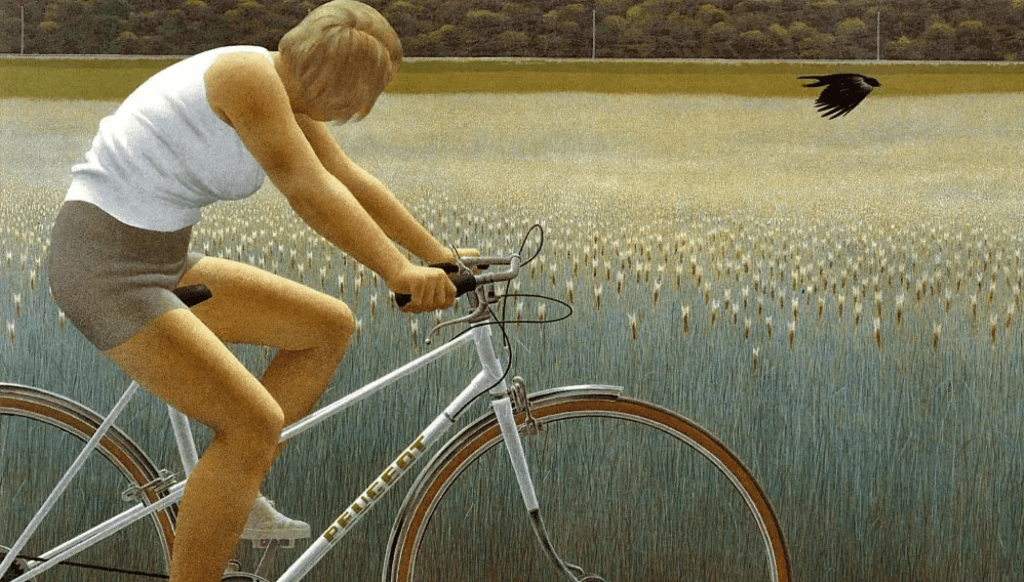
There is something a little eerie, perhaps, about the idea of a month of crows. As much as we’re intrigued by these birds, they also carry fearful associations for humans. This particular member of the corvid family has long been thought of as a harbinger of the ominous. The paintings of the Canadian artist Alex Colville, already uncanny for their close approximation of reality, are only made more so by the presence of crows. His work Cyclist and Crow, on display at the Museum of Fine Arts here in Montreal, features an anonymous rider and a jet-black bird coasting alongside her – a memento of the malevolent.
But crows also have a well-earned reputation for intelligence, for problem-solving abilities and for remembering faces. They are indeed bird-brained, but that can be no insult given their evident ability to assess a situation and determine a course of action. I love their strutting syncopation – the way they almost dance along the asphalt or a tree branch. Their songs or vocalizations are also more varied than that loud, morning “cawing” that we often find simply annoying. As difficult as it may be to believe, they are a type of songbird!
Most beautiful about the life of crows is their sharing in a kind of community. They will settle into treetops by the hundreds and thousands at night. As I put it in a poem once (yes, a poem about crows!): “Mustering, thousands-strong for nighttime / avian community, friendship, protection, / beauty for those who will see.” There always seems something beautiful and God-given about such communities in nature, even if their formation is driven largely by instinct. And would it be any kind of insult to say that our own participation in life together is as driven by instinct as that of the crows?
It was from their nighttime of roosting together that the crows became a wave of black-feathered friends over Reuben’s head and mine each morning. In our shared trajectory with them, it almost felt like we were part of their rag-tag, slightly chaotic community in flight. Those early morning walks of more than a decade ago have translated into an ongoing curiosity and fondness for crows. As always, the best gifts (that which is truly a gift) can’t be anticipated – and certainly not reciprocated.
 encrusted words
Leave a comment